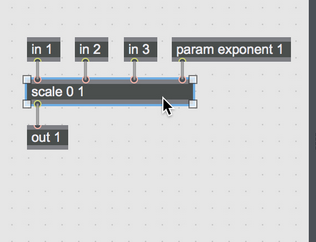
Your assignment is to spend at least 3 hours immersed in Gen~ content. This is a totally new context for creating and will require a significant time investment over the course of the semester. We need to front load that.
requirements
download Max 8 from www.cycling74.com. You may need to make an account and begin a free trial. License codes will be supplied from your course fee before that ends.
Watch the videos below in order. Patch along with the first and second. Save the patches as separate patches.
Zip the patches together and submit to Blackboard.
// declare our variables
// 3 ways to declare a variable: const; var; let

let d = 3; // diameter of the circle
let r = d / 2; // calculate the radius
let xOffset = 0; // left hand margin (not including the radius of the circle)

let numCircles = 200; // control the number of circles

function setup() {
  createCanvas(400, 400);
  console.log(d,r);
}

function draw() {
  background(220);


 for (let i = 0;i<numCircles;i=i+1) {
    // and to repeat it!!! for a certain number of times
  circle(xOffset+d*i,100,d);
  }


}
// control panel
let x = 3;
let y = 250;
let w = 10; // width of my circle
let g = 7; // growth rate of my circle, how many pixels are added each time
let num = 150; // number of circles

function setup() {
  createCanvas(500, 500);
  noLoop(); // draw loop only runs once;
}

function draw() {
  background(220);

  // 3 parts to the rules of a for loop
  // for loops need a variable
  // init, where it starts; test, when it should end; update, how it should change
  for (let i = 1; i <= num; i += 1) {
    // the block of code to be repeated
    circle(x * i, y, w);
    //w += g; // takes what w was, and adds whatever is on the right side of it
  }
}
let g = 100;
let offset = 100;
let o = 255; // opacity

function setup() {
  createCanvas(600, 600);
  strokeWeight(2);
  noLoop();
}
function draw() {
  background(204, 0, 100);
  // stroke(greyscale, opacity)
  stroke(255, o);
  // adds a pixel value instead of an index

  //  for loop 1
  for (var x = 20; x < width; x += g) {
    stroke(255, o);
    line(x, 0, x + x / offset, height - 20); // x1, y1, x2, y2
    o -= 1;
  }

  // flor loop 2
  o = 0;
  for (var x = 20; x < width; x += g) {
    // rgb opacity: stroke(r,g,b,opacity)
    stroke(0, 0, 200, o);
    line(x, 0, x + x / offset, height - 20); // x1, y1, x2, y2
    o += 1;
  }
}
let x = 25;
let y = 50;
let d = 20; // diameter of our circle
let r = d / 2;
let num = 10;

function setup() {
  createCanvas(800, 400);
}

function draw() {
  background(220);

  for (let i = 0; i < num; i = i + 1) {
    circle(x * i, y, d); // x,y, diameter
    line(x * i - r, y - r, x * i - r, y + r); // 2 xy pairs for the start and stop
    line(x * i + r, y - r, x * i + r, y + r); // 2 xy pairs for the start and stop
  }

  noLoop();
}
// declaring a varable
let x = 20;
let y = 20;
let w = 20; // w is the width of my rectangle
let h = 10; // h is the height of my rectangle
let spz = 20; // spacing between shapes

function setup() {
  createCanvas(800, 400);
  noFill();
}

function draw() {
  background(220);

  // index
  for (let i = 0; i < 20; i = i + 1) {
    rect(x + spz * i, y, w, h);
    line(x + spz * i, y - h / 2, x + w + spz * i, y + h * 1.5);
    line(x + spz * i, y + h * 1.5, x + w + spz * i, y - h / 2);
  }
}
function setup() {
  createCanvas(480, 800);
}

function draw() {
  background(204);
  for (var i = 20; i < 400; i = i + 20) {
    stroke(i, 100, 10);
    strokeWeight(i / 20);
    line(i, 0, i + i / 2, 800 - i);
  }

  noLoop();
}
// global scope variables
let numLines = 250; // change var to affect for loop function and drawing spacing!
let xOffset = 50; // x starting point
let spacing; // declare but not define spacing;

function setup() {
  createCanvas(480, 480);
  strokeWeight(0.5);
  // updating a global scope
  spacing = (width - xOffset) / numLines; // 280
}

function draw() {
  background(10);
  // repeats code for a given number of iterations based on the rules inside the parentheses
  for (let x = xOffset; x < width - xOffset * 2; x += spacing) {
    // rgb range is 0 to 255;
    let b = map(x, xOffset, width, 100, 255); // number that belongs to a range, old range min, old range max, new range min, new range max
    let r = map(x, xOffset, width, 255, 100); //
    stroke(r, 100, b);

    // code to be repeated
    let y = height - x * 2;
    line(x, 0, x + x / 2, y); // 1st set is top, 2nd is elbow
    line(x + x / 2, y, x, height); // 1st set is elbow, 2nd is bottom
  }
}
// define our variables
// control panel
// variable declaration:
// let: declares a variable (something that can change)
// var: like let but older, still works
// const: declares a constant (cannot be changed)

// camelCaseStyle -- this is not a syntactical rule!
// style guide for variables -- be short but clear!
// single equal sign is always used for declaration of variables
// if you need to use the ma60hematical equals, you write ==;

// global variables are accesible anywhere in the sketch!
// do *you* need to change it in order to see something different? if yes it should be a global variable, if not it might not need to be
let vOffset = 150; // the number of pixels between the top and bottom of canvas and the start and end of the line
let xSpacing = 10; // the horizontal spacing between lines
let numLines = 60; // number of lines

function setup() {
  createCanvas(400, 600);
}

function draw() {
  background(220);
  // local scoped variable! only useable within the context of the draw loop.

  // code inside () are the rules and conditions for repeating the for loop
  // (start;stop;change)
  // start: declare a variable e.g. let i = 0;
  // stop: when should the computer repeat the for loop ? (if the condition it true, the computer will repeat. if not it will exit the for loop and do the next thing)
  // we program rules and conditions around a variable

  // two styles for writing rules and conditions
  // book style: you are thinking in terms of a visual result (position on the canvas, color amount, opacity)
  // index style: where you are thinking it terms of the number of repetitions

  // code inside the {} is the code to be repeated in the for loop.
  for (let i = 0; i < numLines; i++) {
    line(20 + xSpacing * i, vOffset * i/12, 60 + xSpacing * i/9, height - vOffset);
  }
}
// variables
let d = 20; // diameter of the circle
let r = d / 2; // radius of the circle

let inclineFactor = 5; // how much the circles go down

let xOffset = 20;
let numCircles = 20; // number of circles in each row

function setup() {
  createCanvas(400, 400);
  console.log(r);
}

function draw() {
  background(220);
  // radius is half the diameter
  // diameter is the width of the circle cutting thru its center point
  // radius is the distance between the center of the circle to anywhere on its edge


  for (let i = 0; i < numCircles; i = i + 1) {
    // the code I want to repeat!

    fill(i*20,200-i*10,0)
    circle(xOffset + d * i, 100 + i * inclineFactor, d); // x,y,d
  }
}
// declare our variables
// 3 ways to declare a variable: const; var; let

let d = 20; // diameter of the circle
let r = d / 2; // calculate the radius
let xOffset = 0; // left hand margin (not including the radius of the circle)

let numCircles = 200; // control the number of circles

function setup() {
  createCanvas(400, 400);
  console.log(d,r);
}

function draw() {
  background(220);

  let g = 0;
 for (let i = 0;i<numCircles;i=i+1) {
    // and to repeat it!!! for a certain number of times

   fill(100,g,200)
   circle(xOffset+d*i,100,d-i);
   g+=10;
  }


}